
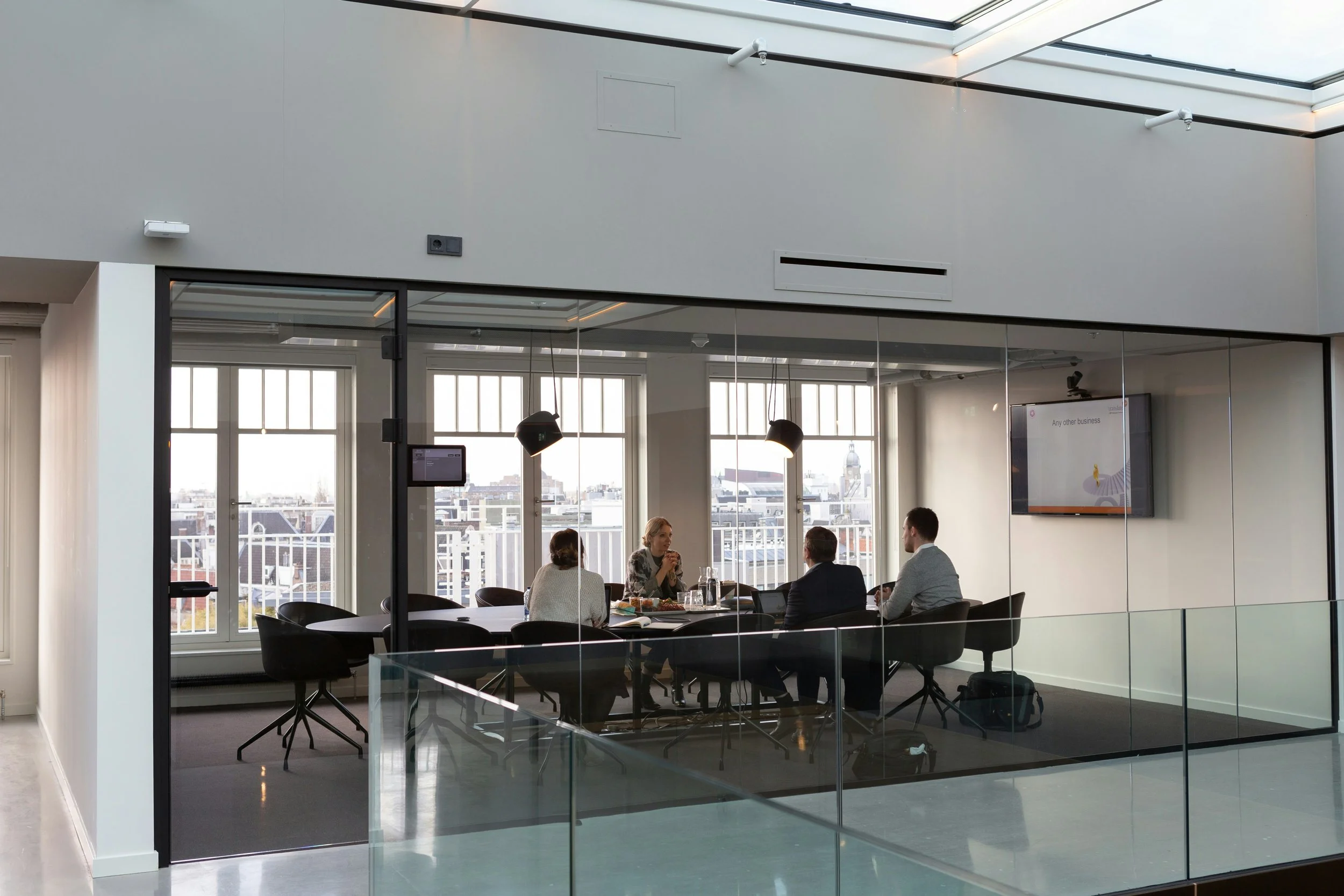
Most speech privacy failures aren't caused by poor walls. They're caused by sound finding another way out.
In today's workplace, confidential conversations happen everywhere. HR discussions, performance reviews, board meetings, client calls and commercially sensitive conversations are all part of daily business life. Yet many organisations are surprised to discover just how easily those discussions can be overheard outside the room they are taking place in.
Whether you're an architect designing a new office, or a facilities manager responsible for an existing workplace, speech privacy is often one of the most overlooked aspects of office design. The good news is that, with the right approach, it can be addressed. The key is understanding where the problem really lies.
Firstly, what is speech privacy?
Speech privacy is the ability to prevent conversations from being understood by people outside the room in which they are taking place.
One of the biggest misconceptions is that speech privacy requires a soundproof office or meeting room. In reality, true soundproofing is rarely necessary in a workplace environment and can be extremely expensive to achieve. The goal isn't complete sound isolation. The goal is to ensure conversations cannot be clearly understood by unintended listeners.
In acoustic terms, the objective is to make speech unintelligible outside the space. People may still be aware that a conversation is taking place, but if individual words and sentences cannot be distinguished, an effective level of speech privacy has been achieved.
The level of privacy required will vary depending on the space. A general meeting room may only require a moderate level of privacy, while boardrooms, HR meeting rooms, legal consultation spaces and executive offices often demand a much higher level of confidentiality.
The problem is that many workplaces assume that because a wall separates two spaces, conversations will naturally stay within them. Unfortunately, sound doesn't always behave that way.
Understanding Flanking Paths (the common culprit affecting speech privacy)
When people discover that conversations can be heard outside a meeting room, the first assumption is usually that the wall isn't performing properly.
In my experience, that is rarely the main issue.
More often than not, speech is escaping through flanking paths. These are indirect routes that allow sound to travel around a partition rather than through it. Even where a wall has been designed to achieve a high acoustic rating, relatively small openings elsewhere can significantly undermine its performance.
Common flanking paths include:
Gaps above suspended ceilings
Unsealed service penetrations
Voids behind wall systems
Gaps beneath doors
Glazing junctions and framing details
Window mullions and façade interfaces
Poorly sealed construction joints
I've investigated meeting rooms where contractors had installed multiple services above the ceiling, leaving holes and gaps that effectively bypassed the wall entirely. In other cases, poorly sealed window junctions have allowed conversations to travel freely between neighbouring rooms.
The wall itself may be performing exactly as intended. The sound is simply finding an easier route.
Consider Office Acoustics Much Earlier in the Process
For architects and design teams, speech privacy is significantly easier to achieve during the design stage than it is once a building is complete.
Too often, acoustic requirements are considered late in the process, after mechanical services, ceilings, partitions and glazing systems have already been coordinated. By this point, the opportunities to eliminate potential flanking paths may be limited, and remedial works can become costly.
The most successful projects begin by asking a simple question:
What level of privacy does this space actually need?
Not every room requires the same acoustic performance. A collaborative meeting space will have different speech privacy requirements to a boardroom or confidential interview room. Understanding those requirements early allows the design team to make informed decisions about room layouts, partition construction, glazing systems, door details and service coordination.
The reality is that most speech privacy failures are not the result of a single major mistake. They are the cumulative effect of lots of seemingly minor details that have not been considered together.
That's why involving an acoustician early in the design process can save significant time, cost and frustration later on.
For a broader overview of how acoustic design can be integrated into the architectural process from the outset, read our guide: Acoustic Design for Architects: What You Need to Know.
Why Sound Masking Is Often the Answer
For existing offices, identifying and sealing every potential sound leakage path can be difficult, disruptive and expensive, therefore many organisations find themselves searching for a practical solution that improves privacy without major construction work and structural changes to the building.
That solution is more often than not, sound masking.
Rather than attempting to eliminate every route through which sound is travelling, sound masking introduces a carefully controlled background sound into surrounding spaces. This reduces speech intelligibility, making conversations significantly harder to understand.
In simple terms, someone outside the room may still be aware that a conversation is taking place, but they are far less likely to make out specific words, sentences or sensitive information.
This approach can be particularly effective where speech privacy issues are being caused by numerous flanking paths hidden within the construction.
We've worked on projects where clients initially assumed they needed extensive building alterations, only to discover that a well-designed sound masking system achieved the desired privacy levels far more efficiently and with considerably less disruption.
For occupied workplaces, that can make all the difference.
Need Advice on Speech Privacy?
Whether you're planning a new development, designing a refurbishment, or looking to improve privacy in an occupied workplace, Acoustics Design can help identify the source of the problem and recommend the most effective solution.
To discuss your project and arrange an acoustic assessment, get in touch with the Acoustics by Design team today.

About the author
Colin Rawlings, MIoA – MD of Acoustics by Design
A qualified acoustician with over two decades of experience, Colin specialises in workplace acoustic solutions across the UK and Europe, delivering consultancy, CPDs, and seminars, making complex acoustic challenges simple for architects, designers, and businesses.